Use case · Box trucks
The largest mobile
billboard you can buy.
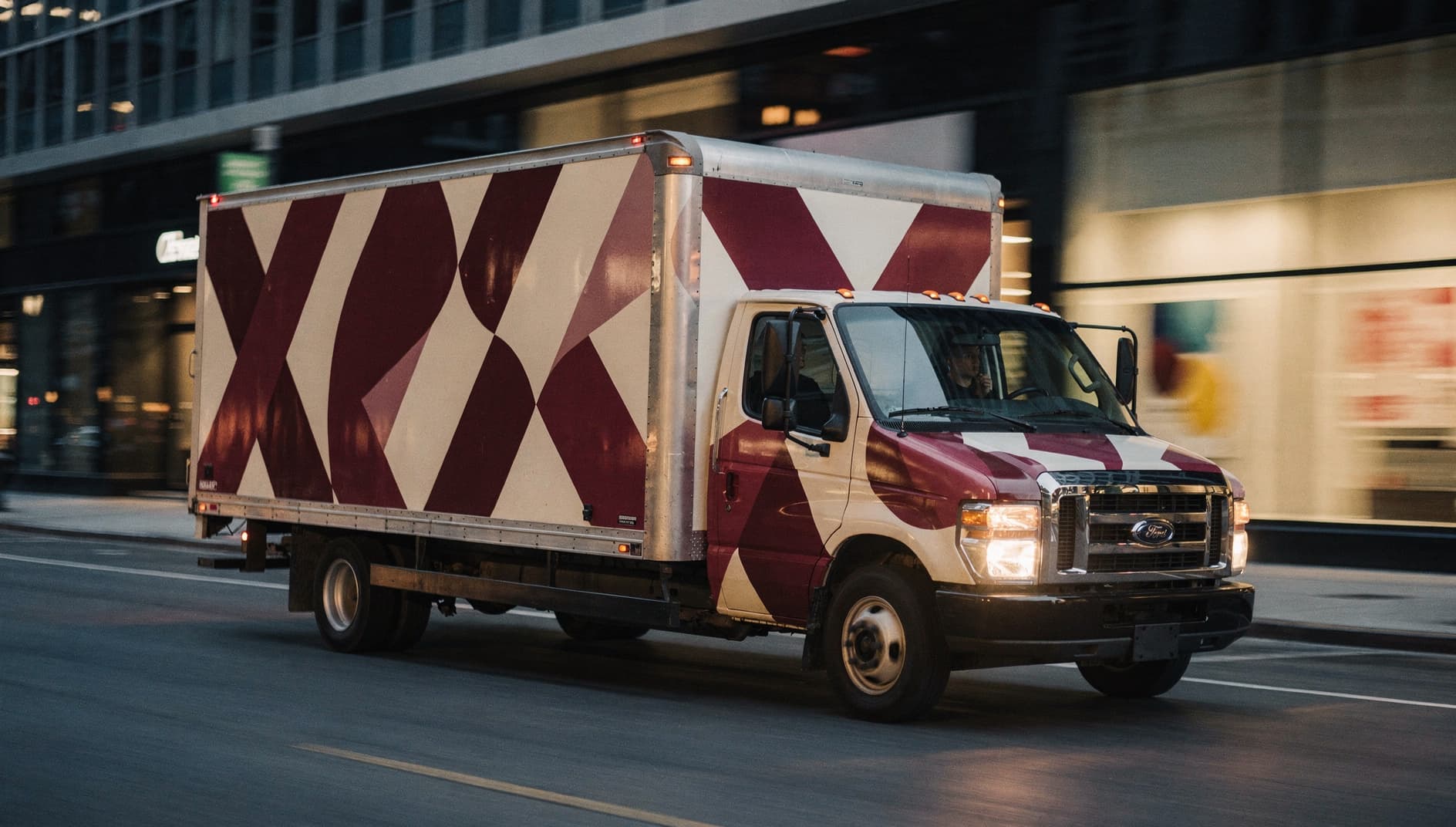
A working box truck offers more readable surface than almost any other format on the road — clean rectangles, no body curves, 16 to 26 feet of side-panel canvas. Surface gives you the chassis and box-length templates to design the cab, the box, the rear roll-up, and the seam between them all in one file.
Why this format
Flat panels.
Big canvas.
Box trucks are the workhorse of food and beverage distribution, moving and storage, building supply, and mobile-billboard advertising. The dominant chassis in the Class 4–6 segment are the Isuzu NPR, Hino 195 and 268, Freightliner M2, and International MV — all common in vocational fleets across North America.
The economics of a box truck wrap are unusual. The cost per thousand impressions can be lower than almost any other outdoor format because the truck is already in service — every mile is a paid mile, and the wrap is a fixed cost laid on top of an existing route.
The box itself is flat, which means generic templates actually work for the side panels — but the cab is chassis specific, the rear roll-up has its own constraints, and the cab-to-box seam is where most generic designs fall apart. The single deliverable is one file that handles all four.
Design considerations
What a box truck
wrap has to handle
Largest mobile billboard
Most working box trucks run 16, 20, 24, or 26 feet long with side panels 6.5 to 9 feet tall. That is more readable real estate than almost any other format on the road. The design has to earn that scale — generous type, a single hero element, and contrast that holds at distance.
Cab-and-box panel breakdown
Side panel, rear roll-up door, cab, cab-to-box continuation. The cab is keyed to the chassis (Isuzu NPR, Hino 195/268, Freightliner M2, International MV) while the box is a flat rectangle. Surface separates them as file groups so they can be quoted, produced, and installed independently.
Roll-up door reality
Rear roll-up doors flex when they roll, which is hard on vinyl. Many operators leave the door bare or apply a separate decal panel rather than wrapping the whole rear. Surface flags the door perimeter so the design choice is explicit, not an afterthought.
Highway and street legibility
A box truck reads at every speed — parked at a loading dock at 5 mph, on a city street at 35, on a highway at 70. The hierarchy that works at 70 mph is one big mark, one short line of copy, one phone number. Detail belongs at the loading-dock distance.
DOT and operator markings
Box trucks at or above 10,001 lb GVWR running interstate need USDOT and operator markings per FMCSA. Lettering size and placement rules apply. Set these up first as a locked layer so they stay correct through revisions.
FMCSA marking requirements depend on operator classification and vehicle weight. Confirm current rules before sending to print.
The workflow
From cab to box to print
01
Pick the chassis and box length
Surface ships separate templates for 14, 16, 20, 24, and 26-foot boxes. The cab template is keyed to the chassis (NPR, Hino, M2, MV). Mix and match to match the operator’s actual truck.
02
Set the regulatory layer
USDOT number, operator name, and any state-required markings get placed first at the right size and lock the layer.
03
Design the side panel
Side panels are clean rectangles with no body curves to fight. Use them for the hero brand element, with the same hierarchy on both sides — the truck doesn’t know which side faces traffic.
04
Decide on the roll-up door
Wrap it, decal it, or leave it bare. Surface lets you toggle the rear-door panel on and off so the install team and the printer are aligned on the choice.
05
Tie the cab to the box
If the design continues from cab to box, plan the alignment in the 3D preview. Surface shows where the cab ends and the box begins so the graphic resolves cleanly across the seam.
Templates
Templates for every box
length and chassis.
14, 16, 20, 24, and 26-foot box lengths. Cab templates for Isuzu NPR, Hino 195/268, Freightliner M2, and International MV. Pick the chassis and the box, and Surface loads both.
FAQ
Common questions
How big is the wrap area on a typical box truck?
What does a box truck wrap cost?
How long does a box truck wrap last?
Do I need separate designs for the cab and the box?
What information should appear on the back roll-up door?
Wrap the box
in Surface.
Free trial. No credit card. Print-ready files for every chassis.
Keep reading
Related work
Solution
Surface for wrap shops
Production-floor view: panel-aware export, photo-real previews, and a workflow that fits the install team.
Open
Use case
Delivery vans
Smaller canvas, similar problem set. Where the van math beats the box-truck math.
Open
Blog
Field notes from the wrap floor
Layout patterns, install gotchas, and the cost math behind a box-truck wrap that earns its mileage.
Coming soon