Use case · Construction trucks
Designed for the
job site.
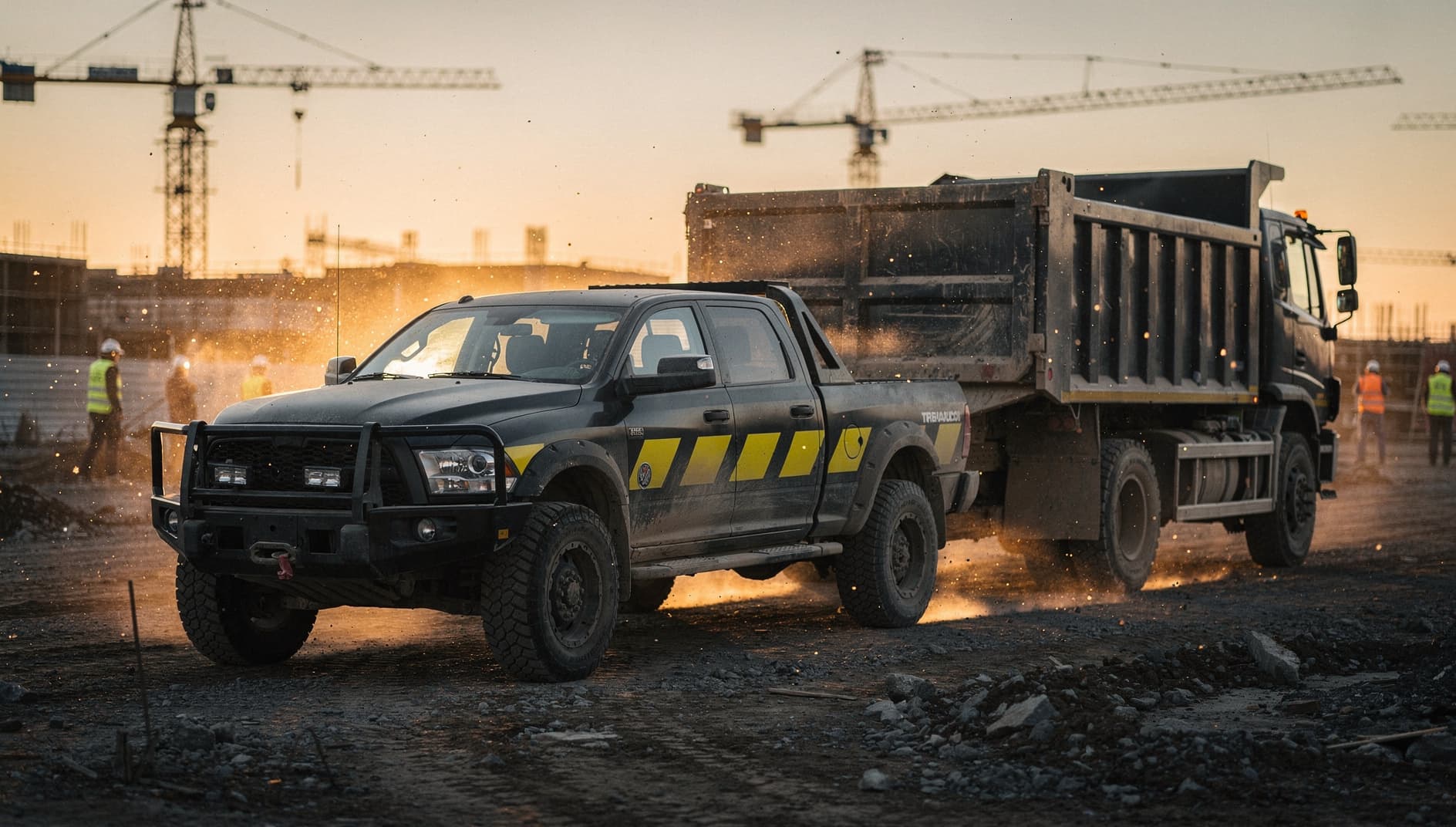
A construction truck wrap takes more abuse than almost any other format on the road. Surface is built around the realities — durable material choices, reflective safety panels, license and DOT placement, and templates that match the actual cab and bed geometry.
Why this format
The most-wrapped
vehicle in the trades.
General contractors, electricians, plumbers, framers, and excavators all run pickups. The Ford F-Series, Chevy Silverado, RAM, and Toyota Tundra dominate the trades fleet, with Ford F-Series consistently the highest-volume vehicle sold in the U.S. across most of the last forty years.
A construction truck is a moving brand impression for the contractor, but it is also a working vehicle that has to survive ladder racks, tool boxes, weld splatter, and the occasional bed-side scrape. The wrap needs material and layout choices that account for that, not consumer-vehicle assumptions ported over.
Larger fleets layer in dump trucks, flatbeds, and rollback-style work trucks for materials handling. The brand has to read across all of them — the design system, not just the design, is the deliverable.
Design considerations
What a construction
wrap has to handle
Job-site durability
A construction truck takes daily abuse — dust, debris, ladder racks, tool boxes, the occasional drywall load shifting in the bed. Cast vinyl with a laminate is the floor for these vehicles, and the design has to assume some panels will get dinged or replaced.
Read at a hundred feet
Construction trucks are most often seen across a parking lot, on a highway shoulder, or staged at a job site. Type and brand mark have to hold at distance — a single hero element with high contrast outperforms a packed layout every time.
Reflective and safety options
Trucks parked on highway shoulders or at night job sites benefit from reflective vinyl panels — chevron tape on rear bumpers and reflective bands on bed sides are common upgrades. Plan the design with those panels in mind so they read as part of the brand, not as bolt-on safety gear.
License and DOT placement
Contractor license display rules vary by state, and any vehicle over 10,001 lb GVWR running interstate may need USDOT and operator markings. Place these as hierarchy elements in the design instead of as final-step decals.
Cab style affects the layout
Regular cab, extended cab (SuperCab, Double Cab), and crew cab (SuperCrew, CrewMax) have different door counts and rear panel geometry. The same design has to adapt across the cab styles in the fleet without losing its hierarchy.
Contractor licensing rules and FMCSA marking thresholds vary by state and vehicle class. Confirm current requirements before finalizing the design.
The workflow
From cab choice to print
01
Pick the chassis
Surface ships pickup templates for F-150, F-250/350, Silverado 1500/2500/3500, RAM 1500/2500/3500, and the Toyota Tundra. Dump-truck templates cover the most common Class 5–7 chassis. Cab style and bed length are first-class filters.
02
Set the regulatory layer first
Drop in contractor license, USDOT number, and any state-required markings at the right size. Lock the layer.
03
Build the brand around the bed
Bed sides are the largest readable panel on a pickup. Use them for the brand mark and primary message. Door logos take the secondary read; tailgate decals take the third.
04
Plan reflective panels into the design
Treat reflective bands, chevron tape, and any safety vinyl as design elements. Surface lets you call out specific panels as reflective so the print order and the install team are aligned.
05
Export panel-ready files
Surface splits the design by panel with bleed and overlap baked in. Cab, doors, bed sides, tailgate — each panel ready for the printer.
Templates
Templates for every truck
the crew runs.
Pickup templates cover F-150 through F-350, Silverado, RAM, and Tundra in every cab style and bed length. Box-truck templates handle the materials-hauling fleet.
FAQ
Common questions
What truck types work best for construction wraps?
Do construction wraps survive job-site conditions?
Is reflective vinyl required for construction trucks?
What information should construction wraps include?
How long do wraps last on heavy-use construction trucks?
Wrap your job-site fleet
in Surface.
Free trial. No credit card. Print-ready files for every truck.
Keep reading
Related work
Solution
Surface for wrap shops
Production-floor view: panel-aware export, photo-real previews, and a workflow that fits the install team.
Open
Use case
HVAC fleet wraps
Adjacent trade, similar problem set. License placement, phone number hierarchy, and fleet consistency.
Open
Blog
Field notes from the wrap floor
Layout patterns, install gotchas, and the cost math behind a construction-fleet wrap that earns its place.
Coming soon