Use case · HVAC fleets
The truck that
books the call.
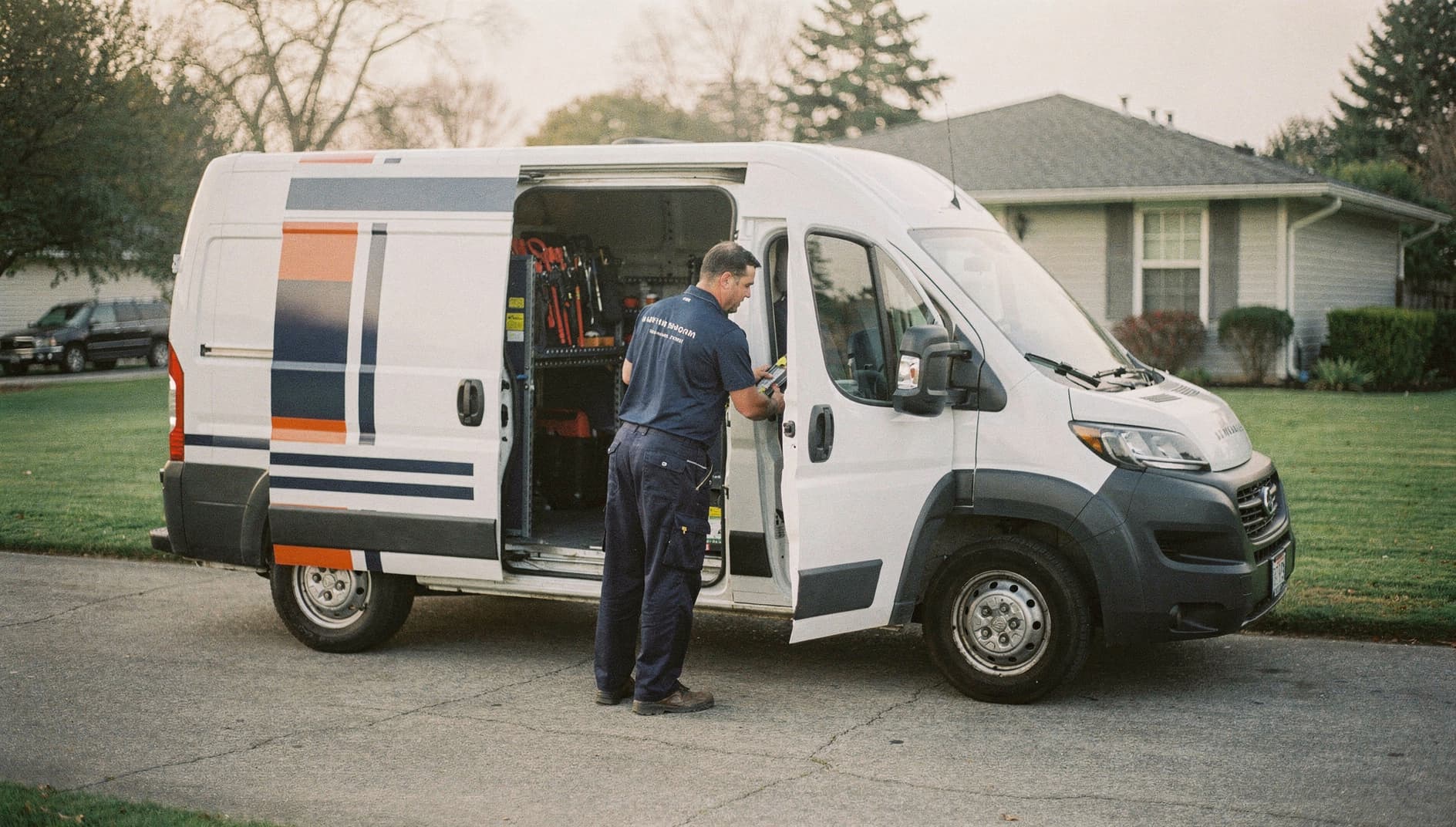
An HVAC service vehicle is a 24/7 lead-gen surface — at the stoplight, in the driveway, on the freeway. Surface is built for the layout decisions that drive service calls: phone number above the hood line, license number sized correctly, fleet consistency across every chassis you run.
Why this format
Service vehicles
that work overtime.
An HVAC fleet typically runs Sprinter or Transit cargo vans for service calls, with a box truck or two for full-system installs. Each vehicle spends most of its day either driving to a call, parked at a stop, or sitting in a customer’s driveway — three different viewing contexts the wrap has to serve at once.
Service-vehicle wraps are a measurable lead source. The phone number on the truck is dialed by neighbors, by drivers at stoplights, and by people who saw the same truck three blocks over last week. Tracking that with a dedicated number on the wrap is the cheapest attribution model in field services.
Most states require contractor license display on commercial service vehicles. Specific rules vary — California (CSLB), Florida, Texas, and others each have their own size and placement guidance. The wrap design has to start from those constraints, not work around them after the fact.
Design considerations
The layout decisions
that drive calls
Phone number above the hood line
An HVAC truck at a stoplight is a billboard for the car behind it. Phone number set above the hood line — typically 8" minimum, often 12" — stays visible from a following vehicle even when the rest of the wrap is partially blocked.
License number prominence
Most states require contractor license display on service vehicles, and several call out specific size or location requirements (California's CSLB rule is the most-cited example). Treat the license callout as a hierarchy element, not a corner sticker.
Service-list legibility
A short list of services — heating, cooling, indoor air quality, commercial — gives the customer at home a reason to write the number down. Keep it to four lines maximum, with the most-searched service first.
Fleet consistency
Five trucks parked in the same neighborhood double the perceived footprint of the business. That only works if the wrap reads as the same brand across Sprinter, Transit, and the occasional box truck. Plan the design around the constants — color, type, hierarchy — and let the panel layout adapt to each chassis.
Driveway-side, not just street-side
An HVAC truck spends three or four hours sitting in a driveway. The neighbor sees the truck more than the homeowner does. Treat the curb side and the driver side with equal weight — the lead generation is happening on the driveway, not on the highway.
Contractor license display rules vary by state and by trade. Confirm current requirements with your licensing board before finalizing the design.
The workflow
From single truck to full fleet
01
Pick the chassis
Most HVAC fleets run a mix of Sprinter or Transit cargo vans for service calls and a Hino or Isuzu box truck for full-system installs. Surface has all three in the template library, with body panels and door cuts already mapped.
02
Set the regulatory layer first
Drop in the contractor license number, business name, and DOT number at the size and location your state requires. Lock the layer so it survives revisions.
03
Build the call-driver hierarchy
Phone number above the hood line. Service list below. Brand mark consistent with your other marketing. Walk the camera around the 3D vehicle to check that the phone number is readable from any angle a homeowner or a following car would see it.
04
Roll the design across the fleet
Apply the same brand system to every chassis in your fleet. Surface keeps the type, hierarchy, and brand color consistent while the panel layout adapts to each vehicle’s body.
05
Export panel-ready files
Surface splits the design into panels with bleed and overlap baked in. One file per chassis, ready for your printer or in-house production.
Templates
Templates for the chassis
your fleet runs.
Sprinter and Transit cargo vans for service calls. Hino and Isuzu box trucks for full-system installs. Pickup decals for the installer’s personal truck. Surface ships every chassis the average HVAC fleet runs.
FAQ
Common questions
Do I need to display my contractor license number on the wrap?
What HVAC service vehicle types work best for wraps?
How prominent should the phone number be on an HVAC wrap?
How long do HVAC fleet wraps last?
Should the wrap mention the equipment brands I install?
Wrap your service fleet
in Surface.
Free trial. No credit card. Print-ready files for every truck.
Keep reading
Related work
Solution
Surface for wrap shops
Production-floor view: panel-aware export, photo-real previews, and a workflow that fits the install team.
Open
Use case
Delivery vans
Same chassis, different math. How daily mileage changes the design priorities for a high-impressions wrap.
Open
Blog
Field notes from the wrap floor
Layout patterns, install gotchas, and the cost math behind a service-fleet wrap that earns its place on the truck.
Coming soon